import warnings

warnings.filterwarnings("ignore")

import pandas as pd
import numpy as np
import graphviz as gr

color = ["0.3", "0.5", "0.7", "0.9"]
linestyle = ["-", "--", ":", "-."]
marker = ["o", "v", "d", "p"]

pd.set_option("display.max_rows", 6)

gr.set_default_format("png");3장 - 그래프 인과모델
3.1 인과관계에 대해 생각해보기
인과모델은 변수들 사이의 인과 관계를 방향성이 있는 그래프(Directed Acyclic Graph, DAG)로 표현합니다. 노드는 변수를, 화살표는 직접적인 인과 영향을 나타냅니다.
import pandas as pd

data = pd.read_csv("../data/cross_sell_email.csv")
data| gender | cross_sell_email | age | conversion | |
|---|---|---|---|---|
| 0 | 0 | short | 15 | 0 |
| 1 | 1 | short | 27 | 0 |
| 2 | 1 | long | 17 | 0 |
| ... | ... | ... | ... | ... |
| 320 | 0 | no_email | 15 | 0 |
| 321 | 1 | no_email | 16 | 0 |
| 322 | 1 | long | 24 | 1 |
323 rows × 4 columns
3.1.1 인과관계 시각화
인과 그래프를 사용하면 복잡한 변수 간의 관계를 시각적으로 명확하게 파악할 수 있습니다.
import graphviz as gr

g_cross_sell = gr.Digraph()

g_cross_sell.edge("U", "conversion")
g_cross_sell.edge("U", "age")
g_cross_sell.edge("U", "gender")

g_cross_sell.edge("rnd", "cross_sell_email")
g_cross_sell.edge("cross_sell_email", "conversion")
g_cross_sell.edge("age", "conversion")
g_cross_sell.edge("gender", "conversion")

g_cross_sell
g_cross_sell = gr.Digraph()
g_cross_sell.edge("U", "conversion")
g_cross_sell.edge("U", "age")
g_cross_sell.edge("U", "gender")
g_cross_sell.edge("rnd", "cross_sell_email")
g_cross_sell.edge("cross_sell_email", "conversion")
g_cross_sell.edge("age", "conversion")
g_cross_sell.edge("gender", "conversion")
g_cross_sell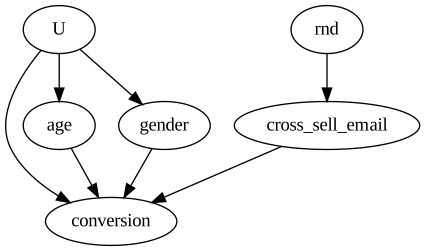
# rankdir:LR layers the graph from left to right
g_cross_sell = gr.Digraph(graph_attr={"rankdir": "LR"})

g_cross_sell.edge("U", "conversion")
g_cross_sell.edge("U", "X")

g_cross_sell.edge("cross_sell_email", "conversion")
g_cross_sell.edge("X", "conversion")

g_cross_sell
g_cross_sell = gr.Digraph(graph_attr={"rankdir": "LR"})
g_cross_sell.edge("U", "conversion")
g_cross_sell.edge("U", "X")
g_cross_sell.edge("cross_sell_email", "conversion")
g_cross_sell.edge("X", "conversion")
g_cross_sell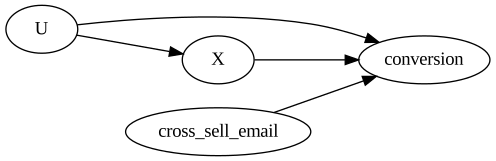
3.1.2 컨설턴트 영입 여부 결정하기
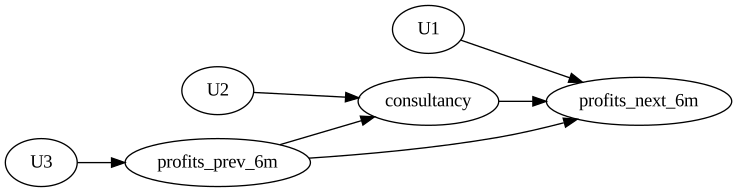
컨설턴트 영입이 이윤에 미치는 영향을 파악하기 위해 그래프로 모델링해 봅니다.

3.2 그래프 모델 집중 훈련
3.2.1 사슬
g = gr.Digraph(graph_attr={"rankdir": "LR"})

g.edge("T", "M")
g.edge("M", "Y")
g.node("M", "M")


g.edge("causal knowledge", "solve problems")
g.edge("solve problems", "job promotion")

g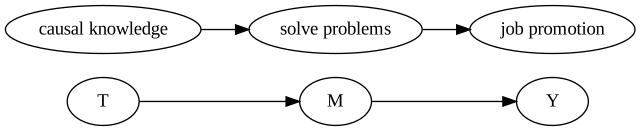
g = gr.Digraph(graph_attr={"rankdir": "LR"})

g.edge("T", "M")
g.edge("M", "Y")
g.node("M", "M")
g.node("M", color="lightgrey", style="filled")


g.edge("causal knowledge", "solve problems")
g.edge("solve problems", "job promotion")
g.node("solve problems", color="lightgrey", style="filled")

g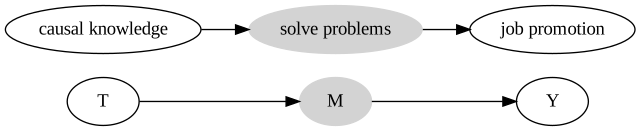
3.2.2 분기
g = gr.Digraph()


g.edge("X", "Y")
g.edge("X", "T")
g.node("X", "X")

g.edge("statistics", "causal inference")
g.edge("statistics", "machine learning")

g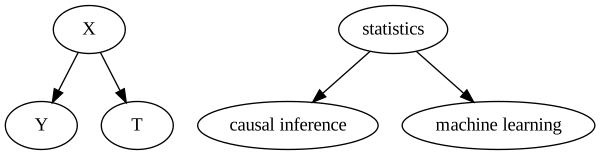
g = gr.Digraph()

g.edge("good programmer", "can invert a binary tree")
g.edge("good programmer", "good employee")

g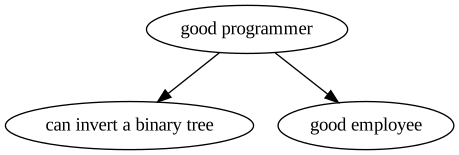
3.2.3 충돌부
g = gr.Digraph()

g.edge("Y", "X")
g.edge("T", "X")

g.edge("statistics", "job promotion")
g.edge("flatter", "job promotion")

g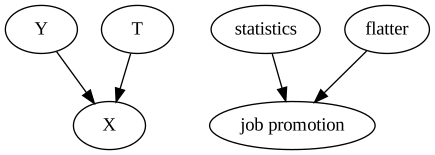
g = gr.Digraph()

g.edge("Y", "X1")
g.edge("T", "X1")
g.edge("X1", "X2")
g.node("X2", color="lightgrey", style="filled")

g.edge("statistics", "job promotion")
g.edge("flatter", "job promotion")
g.edge("job promotion", "high salary")

g.node("high salary", color="lightgrey", style="filled")

g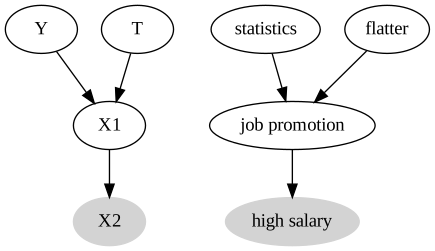
3.2.4 연관관계 흐름 커닝 페이퍼
3.2.5 파이썬에서 그래프 쿼리하기
g = gr.Digraph(graph_attr={"rankdir": "LR"})
g.edge("C", "A")
g.edge("C", "B")
g.edge("D", "A")
g.edge("B", "E")
g.edge("F", "E")
g.edge("A", "G")

g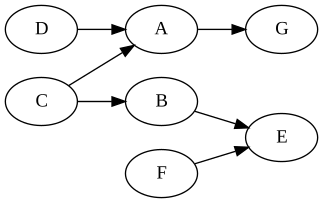
import networkx as nx

model = nx.DiGraph(
    [
        ("C", "A"),
        ("C", "B"),
        ("D", "A"),
        ("B", "E"),
        ("F", "E"),
        ("A", "G"),
    ]
)print("Are D and C dependent?")
print(not (nx.d_separated(model, {"D"}, {"C"}, {})))
print("Are D and C dependent given A?")
print(not (nx.d_separated(model, {"D"}, {"C"}, {"A"})))
print("Are D and C dependent given G?")
print(not (nx.d_separated(model, {"D"}, {"C"}, {"G"})))Are D and C dependent?
False
Are D and C dependent given A?
True
Are D and C dependent given G?
Trueprint("Are G and D dependent?")
print(not (nx.d_separated(model, {"G"}, {"D"}, {})))
print("Are G and D dependent given A?")
print(not (nx.d_separated(model, {"G"}, {"D"}, {"A"})))Are G and D dependent?
True
Are G and D dependent given A?
Falseprint("Are A and B dependent?")
print(not (nx.d_separated(model, {"A"}, {"B"}, {})))
print("Are A and B dependent given C?")
print(not (nx.d_separated(model, {"A"}, {"B"}, {"C"})))Are A and B dependent?
True
Are A and B dependent given C?
Falseprint("Are G and F dependent?")
print(not (nx.d_separated(model, {"G"}, {"F"}, {})))
print("Are G and F dependent given E?")
print(not (nx.d_separated(model, {"G"}, {"F"}, {"E"})))Are G and F dependent?
False
Are G and F dependent given E?
True3.3 식별 재해석
consultancy_sev = gr.Digraph(graph_attr={"rankdir": "LR"})
consultancy_sev.edge("profits_prev_6m", "profits_next_6m")
consultancy_sev.edge("profits_prev_6m", "consultancy")

consultancy_sev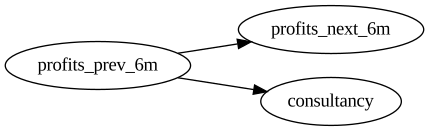
consultancy_model_severed = nx.DiGraph(
    [
        ("profits_prev_6m", "profits_next_6m"),
        ("profits_prev_6m", "consultancy"),
        #     ("consultancy", "profits_next_6m"), # causal relationship removed
    ]
)

not (
    nx.d_separated(consultancy_model_severed, {"consultancy"}, {"profits_next_6m"}, {})
)Trueg_consultancy = gr.Digraph(graph_attr={"rankdir": "LR"})
g_consultancy.edge("profits_prev_6m", "profits_next_6m")
g_consultancy.edge("profits_prev_6m", "consultancy")
g_consultancy.edge("consultancy", "profits_next_6m")
g_consultancy.node("profits_prev_6m", color="lightgrey", style="filled")
g_consultancy
3.4 조건부 독립성 가정과 보정 공식
3.5 양수성 가정
3.6 구체적인 식별 예제
df = pd.DataFrame(
    dict(
        profits_prev_6m=[1.0, 1.0, 1.0, 5.0, 5.0, 5.0],
        consultancy=[0, 0, 1, 0, 1, 1],
        profits_next_6m=[1, 1.1, 1.2, 5.5, 5.7, 5.7],
    )
)

df| profits_prev_6m | consultancy | profits_next_6m | |
|---|---|---|---|
| 0 | 1.0 | 0 | 1.0 |
| 1 | 1.0 | 0 | 1.1 |
| 2 | 1.0 | 1 | 1.2 |
| 3 | 5.0 | 0 | 5.5 |
| 4 | 5.0 | 1 | 5.7 |
| 5 | 5.0 | 1 | 5.7 |
(
    df.query("consultancy==1")["profits_next_6m"].mean()
    - df.query("consultancy==0")["profits_next_6m"].mean()
)1.666666666666667avg_df = df.groupby(["consultancy", "profits_prev_6m"])["profits_next_6m"].mean()
avg_df.loc[1] - avg_df.loc[0]profits_prev_6m
1.0 0.15
5.0 0.20
Name: profits_next_6m, dtype: float64g = gr.Digraph(graph_attr={"rankdir": "LR"})
g.edge("U", "T")
g.edge("U", "Y")
g.edge("T", "M")
g.edge("M", "Y")
g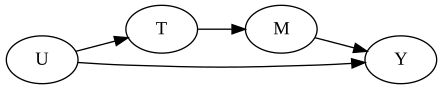
3.7 교란편향
g = gr.Digraph(graph_attr={"rankdir": "LR"})
g.edge("X", "T")
g.edge("X", "Y")
g.edge("T", "Y")

(g.edge("Manager Quality", "Training"),)
(g.edge("Manager Quality", "Engagement"),)
g.edge("Training", "Engagement")

g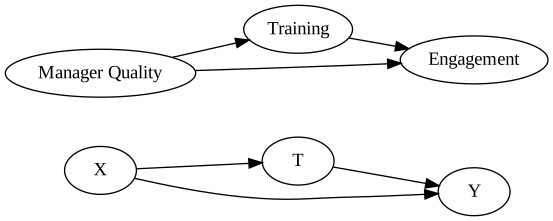
3.7.1 대리 교란 요인
g = gr.Digraph()
g.edge("X1", "U")
g.edge("U", "X2")
g.edge("U", "T")
g.edge("T", "Y")
g.edge("U", "Y")

g.edge("Manager Quality", "Team's Attrition")
g.edge("Manager Quality", "Team's Past Performance")
g.edge("Manager's Tenure", "Manager Quality")
g.edge("Manager's Education Level", "Manager Quality")

g.edge("Manager Quality", "Training")
g.edge("Training", "Engagement")
g.edge("Manager Quality", "Engagement")

g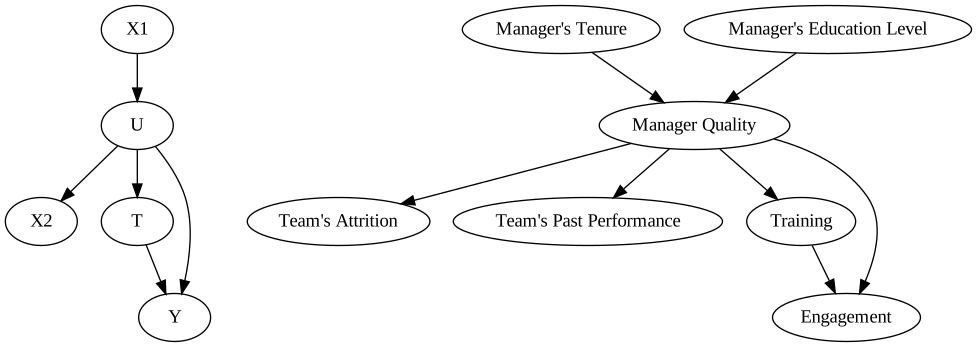
3.7.2 랜덤화 재해석
g = gr.Digraph(graph_attr={"rankdir": "LR"})
g.edge("rnd", "T")
g.edge("T", "Y")
g.edge("U", "Y")

g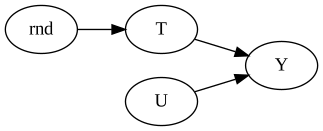
3.8 선택편향
3.8.1 충돌부 조건부 설정
g = gr.Digraph(graph_attr={"rankdir": "LR"})
g.edge("T", "S")
g.edge("T", "Y")
g.edge("Y", "S")
g.node("S", color="lightgrey", style="filled")

(g.edge("RND", "New Feature"),)
(g.edge("New Feature", "Customer Satisfaction"),)
(g.edge("Customer Satisfaction", "NPS"),)
(g.edge("Customer Satisfaction", "Response"),)
(g.edge("New Feature", "Response"),)
g.node("Response", "Response", color="lightgrey", style="filled")

g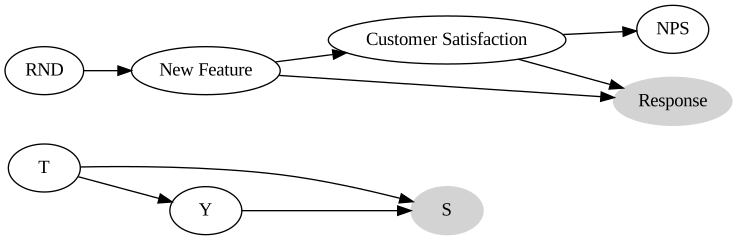
nps_model = nx.DiGraph(
    [
        ("RND", "New Feature"),
        #     ("New Feature", "Customer Satisfaction"),
        ("Customer Satisfaction", "NPS"),
        ("Customer Satisfaction", "Response"),
        ("New Feature", "Response"),
    ]
)


not (nx.d_separated(nps_model, {"NPS"}, {"New Feature"}, {"Response"}))Truenp.random.seed(2)
n = 100000
new_feature = np.random.binomial(1, 0.5, n)
satisfaction_0 = np.random.normal(0, 0.5, n)
satisfaction_1 = satisfaction_0 + 0.4
satisfaction = new_feature * satisfaction_1 + (1 - new_feature) * satisfaction_0
nps_0 = np.random.normal(satisfaction_0, 1)
nps_1 = np.random.normal(satisfaction_1, 1)
nps = new_feature * nps_1 + (1 - new_feature) * nps_0
responded = (np.random.normal(0 + new_feature + satisfaction, 1) > 1).astype(int)
tr_df = pd.DataFrame(
dict(
new_feature=new_feature, responded=responded, nps_0=nps_0, nps_1=nps_1, nps=nps
)
)
tr_df_measurable = pd.DataFrame(
dict(
new_feature=new_feature,
responded=responded,
nps_0=np.nan,
nps_1=np.nan,
nps=np.where(responded, nps, np.nan),
)
)
tr_df.groupby("new_feature").mean()| responded | nps_0 | nps_1 | nps | |
|---|---|---|---|---|
| new_feature | ||||
| 0 | 0.183715 | -0.005047 | 0.395015 | -0.005047 |
| 1 | 0.639342 | -0.005239 | 0.401082 | 0.401082 |
tr_df_measurable.groupby("new_feature").mean().assign(**{"nps": np.nan})| responded | nps_0 | nps_1 | nps | |
|---|---|---|---|---|
| new_feature | ||||
| 0 | 0.183715 | NaN | NaN | NaN |
| 1 | 0.639342 | NaN | NaN | NaN |
tr_df_measurable.groupby(["responded", "new_feature"]).mean()| nps_0 | nps_1 | nps | ||
|---|---|---|---|---|
| responded | new_feature | |||
| 0 | 0 | NaN | NaN | NaN |
| 1 | NaN | NaN | NaN | |
| 1 | 0 | NaN | NaN | 0.314073 |
| 1 | NaN | NaN | 0.536106 |
tr_df.groupby(["responded", "new_feature"]).mean()| nps_0 | nps_1 | nps | ||
|---|---|---|---|---|
| responded | new_feature | |||
| 0 | 0 | -0.076869 | 0.320616 | -0.076869 |
| 1 | -0.234852 | 0.161725 | 0.161725 | |
| 1 | 0 | 0.314073 | 0.725585 | 0.314073 |
| 1 | 0.124287 | 0.536106 | 0.536106 |
3.8.2 선택편향 보정
g = gr.Digraph()

g.edge("U", "X")
g.edge("X", "S")
g.edge("U", "Y")
g.edge("T", "Y")
g.edge("T", "S")
g.node("S", color="lightgrey", style="filled")

(g.edge("New Feature", "Customer Satisfaction"),)
(g.edge("Unknown Stuff", "Customer Satisfaction"),)
(g.edge("Unknown Stuff", "Time in App"),)
(g.edge("Time in App", "Response"),)
(g.edge("New Feature", "Response"),)

g.node("Response", "Response", color="lightgrey", style="filled")

g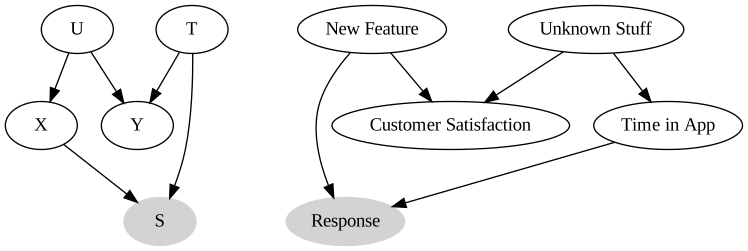
g = gr.Digraph(graph_attr={"rankdir": "LR"})

g.edge("X1", "U")
g.edge("U", "X2")
g.edge("X5", "S")
g.edge("U", "Y", style="dashed")
g.edge("U", "S", style="dashed")
g.edge("U", "X3")
g.edge("X3", "S")
g.edge("Y", "X4")
g.edge("X4", "S")
g.edge("T", "X5")
g.edge("T", "Y")
g.edge("T", "S", style="dashed")
g.node("S", color="lightgrey", style="filled")

g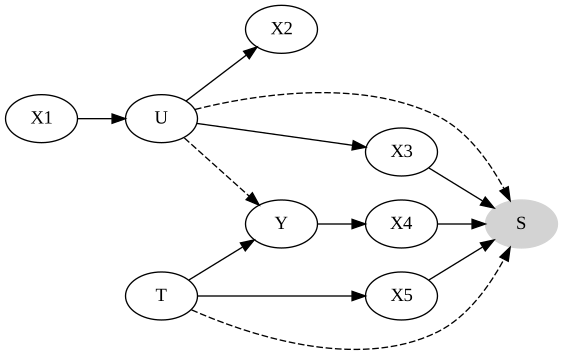
g = gr.Digraph(graph_attr={"rankdir": "LR"})

g.edge("Y", "X")
g.edge("T", "X")
g.edge("T", "Y")

g;
3.8.3 매개자 조건부 설정
g = gr.Digraph(graph_attr={"rankdir": "LR"})
g.edge("T", "M")
g.edge("T", "Y")
g.edge("M", "Y")
g.node("M", color="lightgrey", style="filled")

g.edge("woman", "seniority")
g.edge("woman", "salary")
g.edge("seniority", "salary")
g.node("seniority", color="lightgrey", style="filled")

g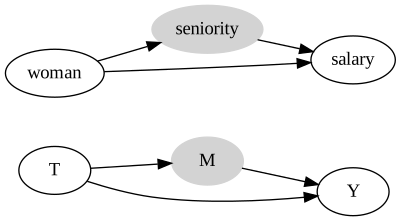
g = gr.Digraph(graph_attr={"rankdir": "LR"})
g.edge("T", "M")
g.edge("T", "Y")
g.edge("M", "Y")
g.edge("M", "X")
g.node("X", color="lightgrey", style="filled")

g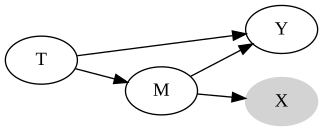
3.9 요약
g = gr.Digraph(graph_attr={"rankdir": "LR", "ratio": "0.3"})
g.edge("U", "T")
g.edge("U", "Y")
g.edge("T", "Y")

g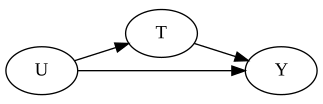
g = gr.Digraph(graph_attr={"rankdir": "LR"})
g.edge("T", "M")
g.edge("M", "Y")
g.edge("T", "Y")
g.edge("T", "S")
g.edge("Y", "S")

g.node("M", color="lightgrey", style="filled")
g.node("S", color="lightgrey", style="filled")

g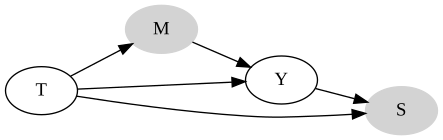
g = gr.Digraph(graph_attr={"rankdir": "LR"})
g.edge("T", "In-Game Purchase")
g.edge("T", "In-Game Purchase > 0")
g.edge("In-Game Purchase", "In-Game Purchase > 0")

g.node("In-Game Purchase > 0", color="lightgrey", style="filled")

g
g = gr.Digraph(graph_attr={"rankdir": "LR"})
g.edge("loan amount", "Default at yr=1")
g.edge("Default at yr=1", "Default at yr=2")
g.edge("Default at yr=2", "Default at yr=3")
g.edge("U", "Default at yr=1")
g.edge("U", "Default at yr=2")
g.edge("U", "Default at yr=3")

g.node("Default at yr=1", color="lightgrey", style="filled")
g.node("Default at yr=2", color="darkgrey", style="filled")

g